Thursday, 3 December 2015


Sunday, 18 October 2015
Timeless Fx Watch Tower
AUDUSD
Outlook in AUD/USD is unchanged.
We'd continue to expect strong resistance from 38.2% retracement of 0.8161 to
0.6905 at 0.7385 to complete the consolidation from 0.6905. Below 0.7164
0.71089 minor support will turn bias
back to the downside for retesting 0.6905 low. However, sustained break of
0.7385 will put 0.75542/0.7625 key resistance in focus.
In the longer term
picture, at this point, we're not anticipating a break of 0.6008, 2008 low.
but i am expecting
prices to hold 0.7168 and 0.7189 support
zone in minor wave to for a third wave rally to key Resistance zones AUD/USD is
oversold in monthly chart and a medium term rebound is due. Strong support is
expected above 0.6008 to bring medium term bottoming.

4hrs

CAD/JPY
CAD/JPY oil dependant but still highly sensitive to USD/JPY
(dovish fed less of a interest hike)
·
Catalyst
will be on Wednesday CAD bank of Canada rate decision
·
Monetary
policy report
·
CPI

USDJPY
USD/JPY
here were no surprises from the BOJ policy
minutes, as the central bank maintained its aggressive easing program.
USD/JPY's dipped to as low as 118.05 last week
but quickly recovered. So far, price actions from 121.65 is seen as consolidates
pattern. Deeper fall could be seen but we'd expect downside to be contained
above 116.11 and bring another rise. Above 120.34 will target 121.62
resistance. Break will pave the way back to 125.27/85 resistance zone.
We also have an Elwave supportive 2b count up count
up in c to 1st test Resistance @ 121.65
the to break towards 124.26 88.6 fib pull back

1.
Trade Balance: Tuesday, 23:50.
Japan’s trade deficit showed little movement in August, coming in at JPY -0.36
trillion, which was within expectations. The markets are expecting a smaller
deficit in September, with an estimate of JPY -0.07 trillion.
2.
All Industries Activity: Wednesday, 4:30.
The indicator posted a small gain of 0.5% in July, which was within
expectations. The markets are braced for a decline in the August reading, with
an estimate of -0.1%.
3.
Flash Manufacturing PMI: Friday, 1:35. In recent months, this PMI has hovered closed to the
50-level, which separates contraction from expansion. The indicator dipped in
September to 50.9 points, shy of the estimate of 51.3 points. The estimate for
the October report stands at 50.6 points.
4.
Tension is growing towards the October 30th decision with
many analysts contemplating
QE3 in Japan. Yet this might not come so fast.
AUDJPY

AUDJPY FOLLOWING Equities S&P500
waiting for a pull back into buy zone with equities and strong Aussies
D4 play
challenge next fib @ 91.45
GBPUSD

The UK posted strong job numbers last week
and this was enough to overcome the weak negative UK CPI. All in all, the
economy in Britain looks OK. This, combined with poor retail sales and weak manufacturing dataout of
the US helped the pound continue to rally last week.
1.
BOE Governor Mark Carney Speaks: Tuesday,
10:00. Carney will testify before the Treasury Select Committee in London.
Any clues as to future interest rate moves could have a strong impact on the
movement of GBP/USD.
2.
Public Sector Net Borrowing: Wednesday,
8:30. The indicator has posted monthly deficits for most of 2015. In August,
the indicator posted a deficit of GBP 11.3 billion, well above the estimate
of GBP 8.7 billion and marking the highest deficit recorded
in 2015. Another high deficit is expected in the October report, with an estimate
of GBP 9.1 billion.
3.
Retail Sales: Thursday, 8:30. Retail Sales is
the key event of the week and should be treated by traders as a market-mover.
The indicator edged upwards to 0.2% in August, matching the forecast. The
estimate for September stands at 0.3%.

Main scenario:
The pair is trading along an downtrend with target on 1.5345 and 1.5170, that may be expected to continue in case the market drops below support level 1.5500.
Alternative scenario:
An uptrend will start as soon, as the pair rises above resistance level 1.5500, which will be followed by moving up to resistance level 1.5625.
The pair is trading along an downtrend with target on 1.5345 and 1.5170, that may be expected to continue in case the market drops below support level 1.5500.
Alternative scenario:
An uptrend will start as soon, as the pair rises above resistance level 1.5500, which will be followed by moving up to resistance level 1.5625.
EURGBP
WEEKLY
EURGBP HIT THE WEEKLY FIB LOW 88.6

FOLLWED BY A 5 WAVE STRUCTURE IN 1 LOOKING FOR
A 3 WAVE STRUCTURE DOWN IN 2 FOR A 3RD
WAVE UP TARGETING 0.7557 THE 78.00
BUY PRICE 0.72630
0.72378
STOP @ 0.7196

USDCHF
Price within a range 0.9549 and
0.9480
USD/CHF's fall from 0.9842 extend lower last week and further fall could still be seen to lower om a fifth wave line (now at 0.9379). But overall outlook is unchanged. Strong support should be seen above 0.9379 and 0.9261 to contain downside and bring rebound. Above 0.9549 minor resistance will turn bias neutral first. And, an eventual upside breakout is still favored. Decisive break of 0.9842 would target 1.0127 resistance.

EURUSD

The ECB also stepped up its game regarding
inflation and further action: a comment by Nowotny showed us that the central bank does not like a strong currency. In the
US, the poor retail sales certainly hurt the greenback, but it made a comeback with good inflation data. The
ugly contest continues.
The European Central Bank
just can’t let the euro rise. Or so it seems. After we have seen poor data in
the US anddovish messages from quite a few sources,
the ECB strikes back.
ECB
member Ewald Nowotny says it’s quite obvious that an additional set of
instruments is necessary – hinting more QE. EUR/USD falls.
Nowotny
is not necessarily a dovish member of the ECB: he heads the central bank of
Austria, one of the richer countries in the euro-zone. He acknowledged that the ECB is missing its
inflation target and that also core inflation is too low.
This
sent EUR/USD down from the highs of nearly 1.15, 1.1494 to be precise, all the
way down to 1.1425, breaking below the critical 1.1460 line the pair fought so
hard to overcome.
It is
important to note that the US dollar remains weak across the board, and this includes
both safe haven currencies such as the yen as well as risk currencies such as
the Australian and Canadian dollars.
Further
support awaits at 1.1375, followed by 1.1290. 1.1460 turns into resistance, with
1.15 and 1.1560 next in line
Sunday, 19 July 2015
NZDCAD RANGED BETWEEN 0.8602 AND 0.8386
NZDCAD
The NZD/USD is in a freefall. The catalysts behind the selling
pressure are falling dairy prices, expectations of a rate cut by the Reserve
Bank of New Zealand, and the possibility of a rate hike by the U.S. Federal
Reserve.
The 40 percent decline in dairy prices since the start of March
has traders wondering how much impact this would have on the country’s GDP as
well as on the income of farmers. It has also has investors thinking about the
strong possibility the RBNZ will decrease rates later this week.
Last week, Fed Chair Janet Yellen signaled before members of
Congress that the U.S. Federal Reserve is on course for a possible rate hike in
September. She cited improving labor conditions as one reason for the move. She
also added that the crisis in Greece and the turmoil in China should not affect
the central bank’s decision.
With the RBNZ considering a possible rate cut and the Fed a rate
hike, the interest rate differential favors the Fed, making the U.S. Dollar a
more favorable investment. The downtrend is likely to continue this week, but
investors may use Wednesday’s RBNZ Rate Statement as an off.
Because of the sell-off, the RBNZ statement may actually turn
into a sell the rumor, buy the fact situation.

BOC Cut Overnight Rate to 0.5%, Downgraded Growth Forecast
"Significantly"
The Bank of Canada reduced the overnight rate by -25 bps to
0.5%, the lowest level since June 2010. It noted that headline inflation
remained weak and was mainly pressured by low energy prices. On economic
developments, the central bank acknowledged that the slowdown in growth in 1Q15
was driven by a scaling back in energy investment and weaker than expected
non-energy investment. Yet, it expected growth would remain weak in the second
quarter. As such, the BOC revised "significantly downgraded" its GDP
growth forecasts. We expect the rate cut would provide only limited addition
stimulus to the economy.
BOC noted that weakness in global economic developments since
the last meeting has negatively affected Canada's economy. Policymakers lowered
the GDP growth forecast for 2015, to +1.1% from +1.9% estimated earlier in the
year, based on three reasons:
First, Canadian oil producers have lowered their long-term
outlook for global oil prices, and have cut their plans for investment spending
significantly more than previously announced.
Second, China's economy is undergoing a structural transition to
slower, domestic-driven growth, which is reducing Canadian exports of a range
of other commodities
Third, Canada's non-resource exports have also faltered in
recent months. While this is partly due to the first-quarter setback in the
U.S. economy, it's still a puzzle that merits further study.

On inflation, the BOC indicated that the softness of headline
inflation, which had been hovering around the lower bound of the +1% to +3%
target over the past several months, was largely due to low energy prices. Core
inflation, which had moved slightly above +2% "because a decline in the
dollar is raising the prices of imports", would drop to +1.5% to +1.7% of
those factors were eliminated. The central bank stressed that all these
measures of inflation would "converge on the underlying trend",
should the "temporary effects dissipate".
In the BOC Business Outlook Survey released earlier this month,
it pointed to "a diverging outlook across regions". The improvement
in the economic developments was driven by "strengthening US demand".
However, "weak oil prices" continued to "significantly dampen
economic perspectives" in certain sectors and regions. On the job market,
the survey suggested that "the balances of opinion on investment and
hiring intentions are still weak, since firms tied to the energy sector plan to
cut back on their investment and hiring". Yet, the labor gap, overall, was
less extreme than it was a year ago, but the number of firms "still
reporting labor shortages that are restricting their ability to meet demand
remains low". Against the backdrop of strong full-time job growth and
better outlook for future sales, this rate cut would provide very limited addition
stimulus to the economy. We expect the BOC to keep its powder for the rest of
the year. It would, however, maintained a rather dovish stance until mid-2016.
BOC noted that weakness in global economic developments
BOC Cut Overnight Rate to 0.5%, Downgraded Growth Forecast "Significantly"
The Bank of Canada reduced the overnight rate by -25 bps to 0.5%, the lowest level since June 2010. It noted that headline inflation remained weak and was mainly pressured by low energy prices. On economic developments, the central bank acknowledged that the slowdown in growth in 1Q15 was driven by a scaling back in energy investment and weaker than expected non-energy investment. Yet, it expected growth would remain weak in the second quarter. As such, the BOC revised "significantly downgraded" its GDP growth forecasts. We expect the rate cut would provide only limited addition stimulus to the economy.
BOC noted that weakness in global economic developments since the last meeting has negatively affected Canada's economy. Policymakers lowered the GDP growth forecast for 2015, to +1.1% from +1.9% estimated earlier in the year, based on three reasons:
First, Canadian oil producers have lowered their long-term outlook for global oil prices, and have cut their plans for investment spending significantly more than previously announced.
Second, China's economy is undergoing a structural transition to slower, domestic-driven growth, which is reducing Canadian exports of a range of other commodities
Third, Canada's non-resource exports have also faltered in recent months. While this is partly due to the first-quarter setback in the U.S. economy, it's still a puzzle that merits further study.
On inflation, the BOC indicated that the softness of headline inflation, which had been hovering around the lower bound of the +1% to +3% target over the past several months, was largely due to low energy prices. Core inflation, which had moved slightly above +2% "because a decline in the dollar is raising the prices of imports", would drop to +1.5% to +1.7% of those factors were eliminated. The central bank stressed that all these measures of inflation would "converge on the underlying trend", should the "temporary effects dissipate".
In the BOC Business Outlook Survey released earlier this month, it pointed to "a diverging outlook across regions". The improvement in the economic developments was driven by "strengthening US demand". However, "weak oil prices" continued to "significantly dampen economic perspectives" in certain sectors and regions. On the job market, the survey suggested that "the balances of opinion on investment and hiring intentions are still weak, since firms tied to the energy sector plan to cut back on their investment and hiring". Yet, the labor gap, overall, was less extreme than it was a year ago, but the number of firms "still reporting labor shortages that are restricting their ability to meet demand remains low". Against the backdrop of strong full-time job growth and better outlook for future sales, this rate cut would provide very limited addition stimulus to the economy. We expect the BOC to keep its powder for the rest of the year. It would, however, maintained a rather dovish stance until mid-2016.
ACTIONFOREX
Weekly Currency GBPUSD,USDCHF,AUDJPY,EURJPY
GBPUSD

GBPUSD
The GBP/USD finished lower on Thursday as long investors continued to take profits following yesterday’s bearish U.K. unemployment report. The report, which took investors by surprised, showed that unemployment in the U.K. actually increased. This was the first rise in the U.K. Claimant count since 2012. The claimant count rose to 7.0K from -8.9K. The unemployment rate increased to 5.6% from 5.5%. The average wages report also missed the estimate. Traders were pricing in a reading of 3.3%. The actual.
USDCHF

USDCHF
USDCHF rally was likely triggered by hawkish comments from Fed Chair
Janet Yellen. During two days of testimony before Congress, Yellen signaled
that the central bank remains on track for the first rate hike in almost a
decade.
“If the economy evolves as we expect, economic conditions likely
would make it appropriate at some point this year to raise the federal funds
rate target, thereby beginning to normalize the stance of monetary policy,” she
said.
Once again the interest rate differential between the U.S. and
Switzerland is making the U.S. Dollar a more attractive investment. Unless some
unexpected news comes along to derail the U.S. economy, the Fed could begin
raising interest rates as early as September and perhaps a second time in
December.
Yellen also added that the crisis in Greece and the stock market
crash in China have had no effect on the Fed’s plans. Instead, the central
bank’s main focus has been on the improving labor market.
Recent data showed that the Swiss National Bank had to step into
the currency market as the Greek crisis deepened last month. Although it did
not intervene as intensively as it did in 2012, it is likely to remain a player
because of the instability in the region. The uncertainty over Greece’s
financial future remains an issue because it could have a negative effect on
Switzerland’s export-reliant economy.
Upward pressure is expected to continue to support the USD/CHF
because of strengthening expectations for a Fed rate hike and the possibility
that the SNB will have to intervene once again especially after Greek banks
open on Monday after being closed for three weeks.
EURJPY

EUR: Path Clear for Sell-Off.
Bearish.
With uncertainty regarding Greece
diminished, we believe that investors will feel more comfortable reinitiating
EUR shorts, as evidenced by the latest break in EURUSD below the 100 DMA.
Draghi has reiterated that the ECB stands ready to act if needed, which could
be enough to weigh on EUR, particularly if it supports equities, given the inverse
relationship between European stocks and EUR.
AUDJPY

JPY: Still Look for Strength.
Bullish.
We expect JPY weakness to reverse,
and maintain our bullish view, despite the recent pick-up in equity markets.
Recent data from Japanese pension funds point to the reallocation process being
largely complete, suggesting that foreign outflows from Japan could slow. The
latest developments in Japanese politics pose a risk to Abenomics, which could
be a near-term source of support for JPY, though we believe that in the longer
term this could be more concerning.
Write up taken from
actionforex
fxempire
efxnews
Sunday, 10 May 2015


Saturday, 9 May 2015
Weekly Set-up Plans 12/05/2015
AUD/NZD DAILY

CAD/JPY DAILY

GBP/CAD DAILY

AUD/USD Daily

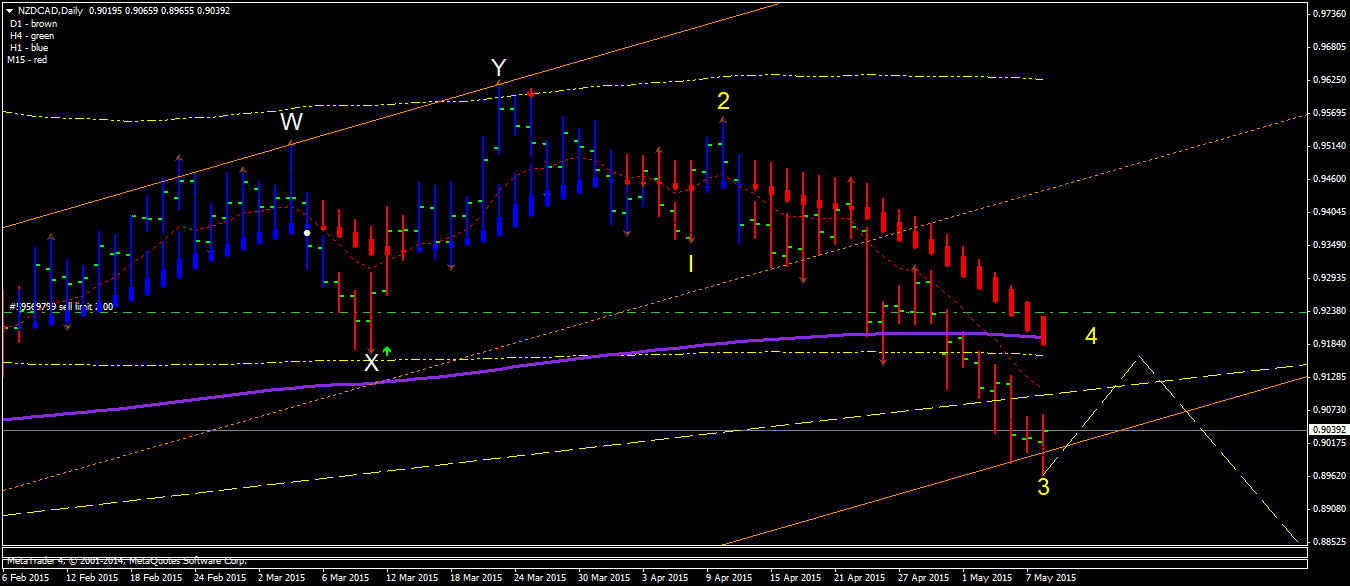
NZD/CAD DAILY
Subscribe to:
Posts (Atom)